

 Sales:
  Customer Service:
Soft Close Cabinet Hinges: Types, How They Work, and How to Adjust Them

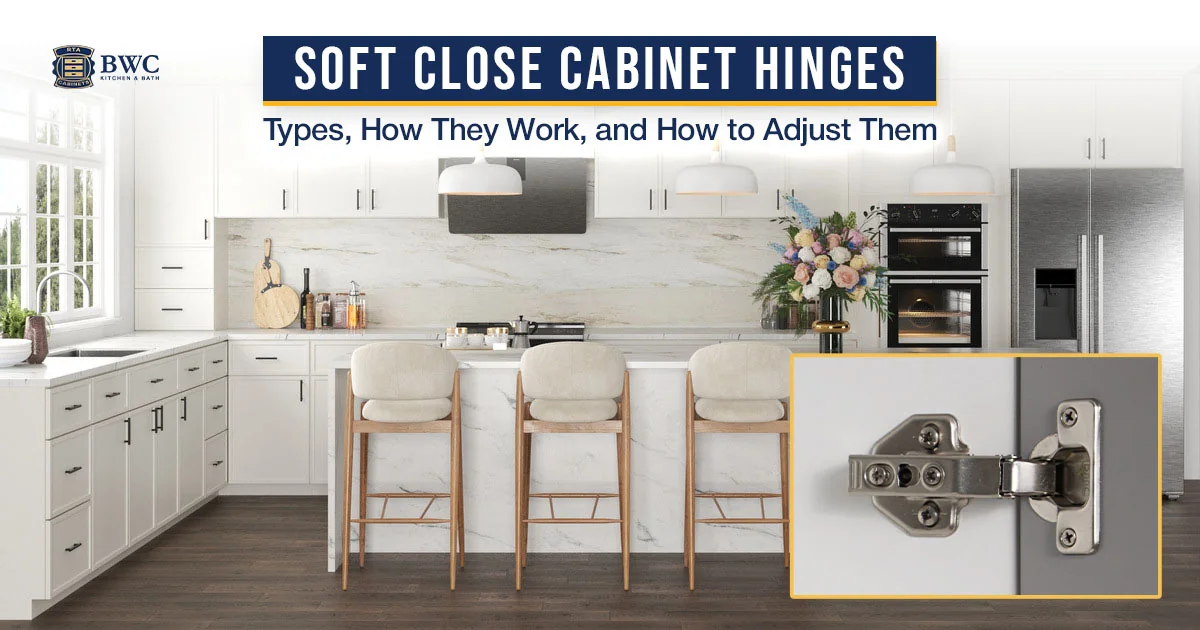
Soft close cabinet hinges are concealed door hinges with a built-in damper that catches the door in the last few inches and eases it shut, silently, with no slam. They sit inside the cabinet so nothing shows from the front, and most are 6-way adjustable, so you can move the door up, down, in, out, and side to side after it is hung. New cabinets usually come with them. Older cabinets can be upgraded, either with a clip-on damper or a matching soft-close hinge.
That last inch of travel is the whole point of this guide. Below is how the damper actually works, the parts you will be told to turn or measure, the hinge types and how to pick the right one, how to fix a door that hangs crooked, and how to add soft close to cabinets that never had it.
In this guide:
- What are soft close cabinet hinges, and how do they work?
- The parts of a concealed soft-close hinge
- Types of cabinet hinges
- How to choose the right soft-close hinge
- How to tell if your cabinet hinges are soft close
- How to adjust soft close cabinet hinges
- Troubleshooting common soft-close hinge problems
- How to add soft close to older cabinets
- Soft close drawer slides go with the hinges
- How long do soft-close hinges last, and how do you maintain them?
- Do you have to buy soft close hinges separately?
- FAQ
What are soft close cabinet hinges, and how do they work?
Take a standard concealed hinge, build a small oil-filled cylinder into the arm, and you have a soft-close hinge. The cylinder does one job. In the last 2 to 3 inches before the door reaches the frame, the oil pushes back against the motion, the door slows, and it settles shut without a sound. Some designs use a calibrated spring or a separate clip-on air damper instead. The result is the same either way: no bang.
Quiet is the obvious part. The bigger reason to care is wear. Every slam sends a shock through the hinge screws, the door, and the box, and over ten years of daily use that is what loosens joints and pulls doors out of square. Stop the slam and the whole cabinet holds up longer. Good soft-close hinges are also tested for tens of thousands of open-and-close cycles, so the damper is rarely the thing that gives out first. Quiet plus durability is why soft close stopped being an upsell and became what buyers now expect as standard.
The parts of a concealed soft-close hinge
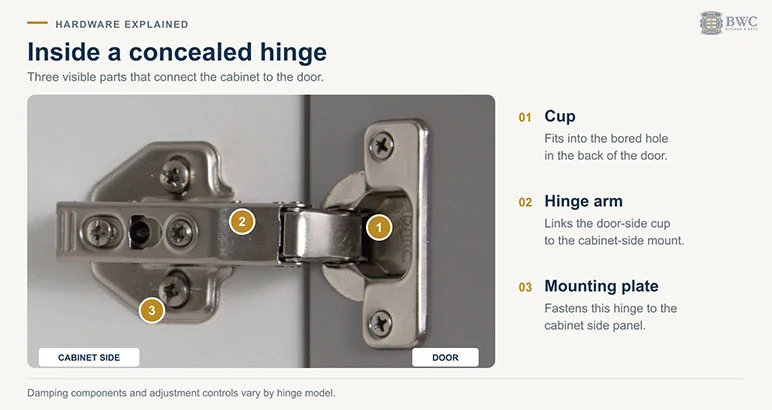
Every instruction further down points at one of these parts, so it is worth two minutes to learn them.
| Part | What it is | Why it matters |
|---|---|---|
| Cup (boss) | The round barrel that presses into a bored hole in the back of the door | Its diameter, usually 35mm, has to match the hole already drilled in your door |
| Hinge arm | The metal arm linking the cup to the mounting plate | Holds the depth and side adjustment screws |
| Mounting plate | The bracket screwed to the cabinet that the arm clips onto | Sets how far the door sits from the top; the type depends on frameless vs face-frame |
| Damper | The oil-filled cylinder, or a clip-on unit, that slows the last inches | This alone is what makes a hinge soft close instead of standard |
| Adjustment screws | Two or three screws on the arm and plate | Give you the 6-way alignment: side, depth, height |
| Tension switch | A small lever on some hinges | Sets the soft-close pull lighter or firmer for the weight of the door |
Here is the useful takeaway: a concealed hinge with a cup, arm, and plate but no damper is just a plain European hinge. The damper is the only difference. That is exactly why you can often add soft close to a cabinet without replacing the whole hinge.
Types of cabinet hinges
There is no single “cabinet hinge.” You are picking four things at once, and a mismatch on any one of them is the usual reason a hinge will not sit right.
| Variable | Options | What it means for you |
|---|---|---|
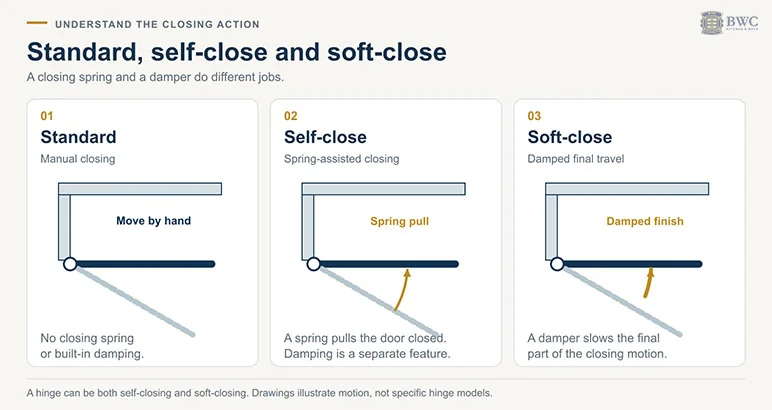
| Closing action | Standard, self-close, soft-close | Standard stays put anywhere. Self-close snaps shut fast in the last inches. Soft-close eases shut slowly and silently. |
| Hinge style | Concealed (European), exposed, semi-concealed | Concealed hides inside and adjusts 6 ways. Exposed and semi-concealed show on the face and rarely soft-close. |
| Overlay | Full overlay, half overlay, inset | Full overlay covers most of the frame edge. Half overlay share a center partition. Inset sits flush inside the frame. |
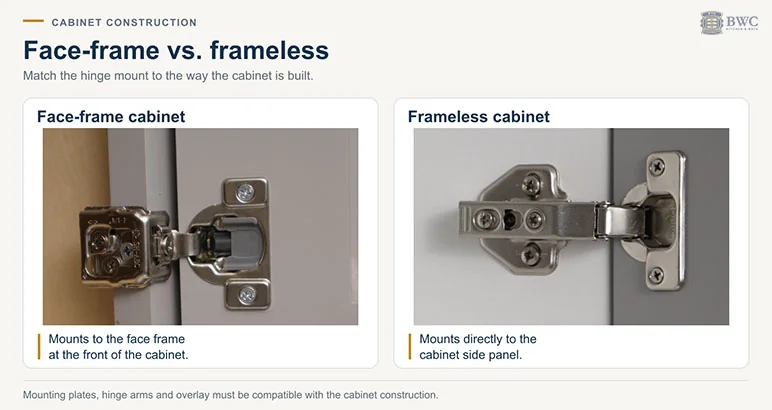
| Cabinet type | Frameless (European), face-frame (framed) | Sets the plate: frameless plates fasten to the side wall, face-frame plates to the front frame. |
| Opening angle | About 95 to 110 degrees standard; 155 to 170 wide-angle | Standard suits most doors. Wide-angle and corner hinges are for doors that have to clear something. |
Almost every soft close cabinet hinge sold today is the concealed European style with a 35mm cup. What actually changes from one kitchen to the next is the overlay, whether the box is frameless or face-frame, and the angle a particular door needs to open.
Concealed and European hinges
“Concealed” and “European” are two names for the same hinge: a cup-and-arm design that hides inside the cabinet and gives you 6-way adjustment. On frameless cabinets the arm clips to a plate on the interior side wall. On face-frame cabinets it clips to a plate on the front frame. Both come in soft close, and both use the 35mm cup, so the door side of the hardware is usually interchangeable. The plate is the part that changes.
Overlay, and how to measure yours
Overlay is the number people get wrong. It is simply how much the closed door laps over the cabinet opening, and buying for the wrong one is why a replacement hinge will never sit flush no matter how far you turn the screws.
- Full overlay: the door covers most of the frame or box edge and leaves a thin reveal. This is what most modern kitchens use.
- Half overlay: two doors share one center partition, so each laps about halfway across it. Common on a double-door cabinet with a middle stile.
- Inset: the door sits flush inside the frame, level with the front. A traditional look, and it needs an inset-specific hinge.
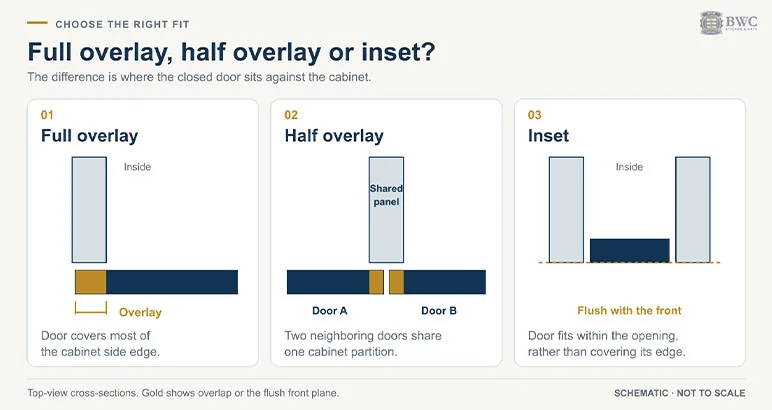
To measure, close the door and check how far the panel laps over the frame on the hinge side. That lap is your overlay. Write it down before you shop.
Soft close vs self close vs standard
| Action | How it closes | Best for |
|---|---|---|
| Standard | Stays at any angle; you push it shut yourself | Utility rooms, garages, doors nobody touches much |
| Self-close | A spring pulls it shut over the last inches, but it can still tap the frame | Doors you want closing on their own, where a little noise is fine |
| Soft-close | A damper slows the last inches so it lands silently | Full kitchens, and anywhere you want quiet and less wear |
For a whole kitchen there is not much of a debate. Soft-close is quieter, easier on the cabinets, and the standard buyers now expect to see.
How to choose the right soft-close hinge
If you are matching a new door or replacing hinges, buying the wrong one almost always comes down to skipping one of these five checks. Go in order.
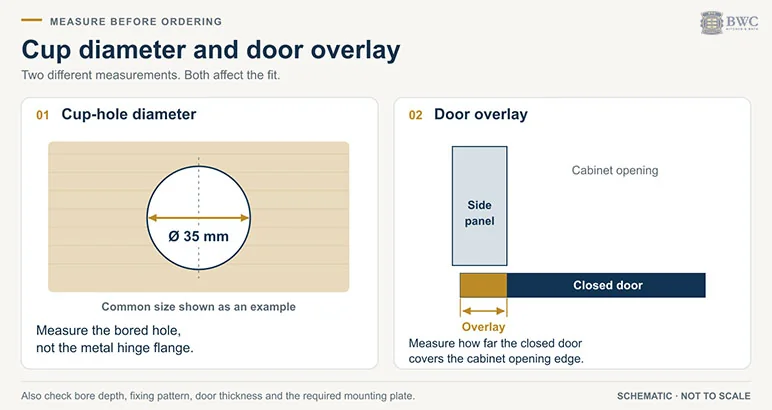
- Cup size. Measure the bored hole in the door. Full-size hinges use a 35mm cup; some thin or specialty doors use a 26mm mini cup. Match it exactly, because the hole is already drilled.
- Frameless or face-frame. Decide whether the plate has to fasten to the side wall (frameless) or to a front frame (face-frame). That picks your plate type.
- Overlay. Measure the lap as above and buy full, half, or inset to match.
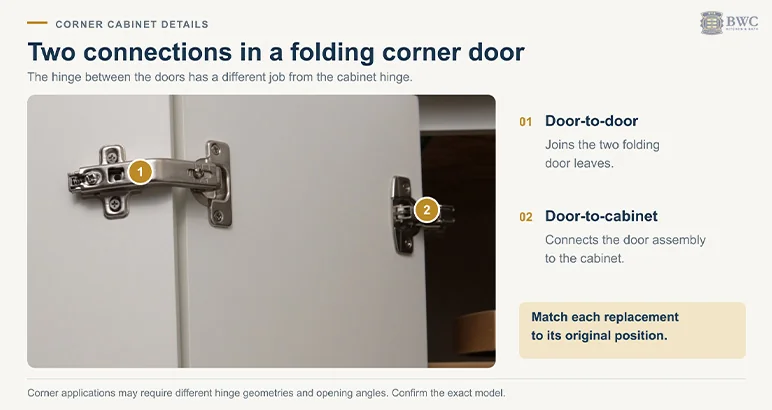
- Opening angle. A standard 95 to 110 degree hinge covers most doors. Only reach for a wide-angle or corner hinge when a door has to open past 90 degrees or clear an obstruction, like a lazy-susan or blind-corner cabinet.
- Hinges per door. A good rule of thumb: two hinges up to about 40 inches of door height, three from roughly 40 to 60 inches, four for anything taller or heavy. More hinges spread the weight and keep a tall door from sagging.
If you are matching what you already have rather than buying a full set, pull one existing hinge first and read the cup size, overlay, and plate type off it. Buy to those three numbers and the new hinge will behave like the old one.
How to tell if your cabinet hinges are soft close
Two quick checks. Open a door, push it slowly toward closed, and let go about three inches out. If it drifts shut on its own and lands soft and silent, it is soft close. If it slams or just stops where you let go, it is not. Then look at the hinge itself: a soft-close version has a small piston or cylinder built into the arm, often with a tiny switch for the softness. A standard European hinge has the same cup and arm, minus that cylinder.
How to adjust soft close cabinet hinges
A 6-way hinge moves the door on three axes, each in two directions, using the screws on the arm and plate. Do one door at a time, turn in quarter turns, and check the gaps again after every change. Small moves fix more than big ones.
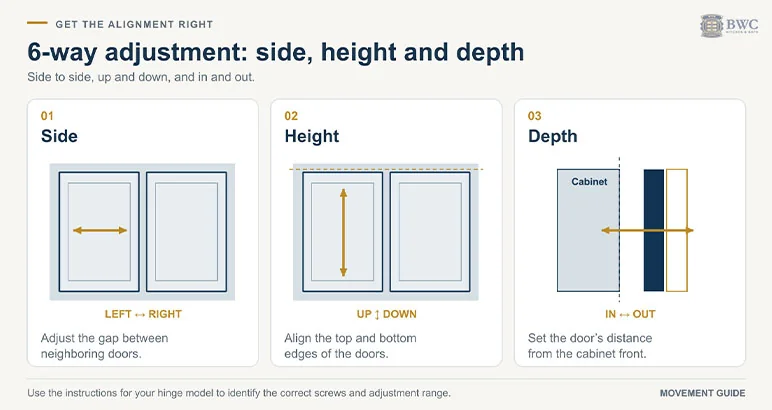
- Side to side. Turn the front screw, the one nearest the door. This slides the door left or right so the reveal between two doors evens out. Start here, since it changes the look the most.
- Depth (in and out). Turn the rear screw, or loosen it and slide the arm, to pull the door toward the frame or push it out. This is the fix for a door that stands proud of its neighbors or rubs the frame.
- Height (up and down). Loosen the screws holding the plate to the cabinet, nudge the door up or down, then retighten. Use it to line up the tops of a row of doors.
Work in that order: side, depth, height. If your hinge has a tension switch, set it lighter for small doors and firmer for tall or heavy ones, so every door still pulls all the way closed and latches.
Troubleshooting common soft-close hinge problems
Most soft-close complaints trace back to a short list of causes. Find the symptom before you decide the hinge is dead.
| Symptom | Likely cause | Fix |
|---|---|---|
| Door will not close all the way | Tension set too weak, or the door is too heavy for it | Turn the tension firmer, or add a hinge to a tall door |
| Door slams and no longer eases shut | Damper worn out, or a standard hinge in that spot | Replace the hinge or clip on a damper |
| Door sags at the outer corner | Loose screws, or too few hinges for the height | Tighten the plate screws, then add a third or fourth hinge |
| Two doors have an uneven gap | Side-to-side alignment off | Turn the front screw on both doors, quarter turn at a time |
| Door rubs the cabinet beside it | Depth or side adjustment off | Back the door in with the rear screw, then even the reveal |
| Hinge keeps popping off the plate | Not fully clipped, or the wrong plate height | Re-seat until it snaps; confirm the plate type matches |
One more thing worth knowing: if a door still will not behave after you have chased every screw, the hinge is probably rated for the wrong overlay. No amount of adjusting fixes that. Only the right hinge does.
How to add soft close to older cabinets
If your cabinets already run concealed European hinges, you have two easy options.
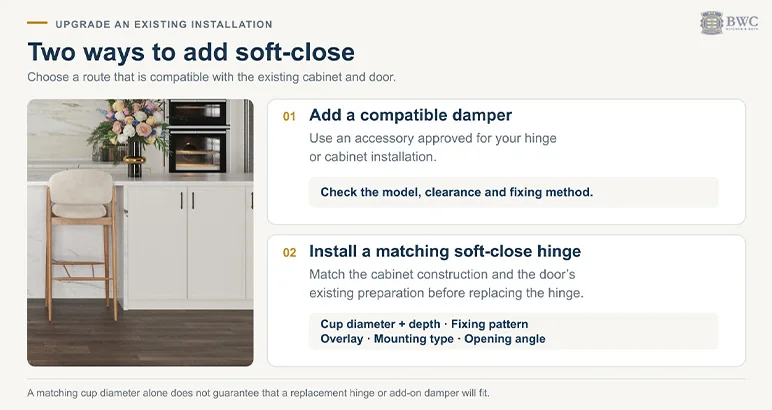
The cheap route is a clip-on damper. These are small air or hydraulic units that snap onto the frame or the hinge arm and cushion the door without touching anything else. Install one, test the door, and add a second if a heavy door needs more bite. Do this when your current hinges work fine and you only want the quiet close.
The cleaner route is a replacement soft-close hinge. Swap the whole hinge for a soft-close version with the same cup size, overlay, and plate type, and because the cup hole is already there, it drops in with a screwdriver in a few minutes per door. Before you buy, unclip one old hinge and read those three numbers off it.
Now the honest part. If your old cabinets use exposed or non-standard hinges, retrofitting gets ugly fast, sometimes down to boring new 35mm cup holes. At that point new doors, or new cabinets, are usually the better spend.
Soft close drawer slides go with the hinges
Doors are only half of it. A kitchen that is quiet everywhere pairs soft-close hinges with concealed undermount, full-extension soft-close drawer slides. Undermount means the slides sit beneath the box and stay hidden. Full-extension means you can reach the very back of a deep drawer instead of fishing for it. If you are upgrading for the soft, quiet feel, buy for doors and drawers together. It looks odd when the doors glide shut and the drawers still bang.
How long do soft-close hinges last, and how do you maintain them?
Years, under normal kitchen use, before the damper starts to feel weak. Upkeep is close to nothing. Wipe grease off the hinge and cup so the arm swings freely, snug up the plate screws if a door starts to droop, and nudge the tension switch back if a door stops latching. When a single damper finally wears out, you replace that one hinge or clip on a damper. You do not redo the whole kitchen.
Do you have to buy soft close hinges separately?
Only if you are keeping the cabinets you have. If you are buying new, do not go hunting for hinges at all. Buy cabinets that already include the hardware and there is nothing to size, match, or install.
The framed and frameless painted lines of ready-to-assemble kitchen cabinets from BuyWholesaleCabinets.com ship with 6-way adjustable concealed soft-close hinges and full-extension soft-close drawer glides as standard, on solid wood dovetail drawer boxes, and on the frameless lines those glides are undermount. No premium tier to unlock, no hardware to source on the side. The one exception is the Unfinished Shaker line, which uses 3-way adjustable soft-close hinges. For every other line, framed shaker styles or frameless kitchen cabinets, the 6-way hardware is listed right on the European-style RTA cabinets category, where it is called out as a feature.
Because the cabinets ship flat and assemble on-site, you get up to 40% savings against big-box pricing, nationwide delivery in 7–10 business days, and wholesale pricing on every order with no program to join. Want to feel the soft-close for yourself before you commit to a full kitchen? Order a sample door and try it at home first.
Frequently asked questions
Are soft close cabinet hinges worth it?
Yes. They stop doors from slamming, which spares the door, the hinges, and the box years of impact, and they make a kitchen quieter to live in. On a full run of cabinets the difference is immediate and it lasts.
Can I add soft close hinges to my existing cabinets?
Usually. If your cabinets already use concealed European hinges with a 35mm cup, you can clip on soft-close dampers or swap in matching soft-close hinges that drop into the existing holes. Exposed or non-standard hinges are much harder to retrofit.
What is the difference between soft close and self close hinges?
Self-close uses a spring to pull the door shut over the last inches, but it can still close fast enough to tap the frame. Soft-close adds a damper that slows the door so it lands silently. Soft-close is the quieter, higher-end option.
How do I stop a soft-close door from slamming?
Check the tension switch first and set it firmer. If it still slams, the damper has probably worn out, or that spot has a standard hinge, so replace the hinge or clip on a damper. A door too heavy for its setting will also slam, and the fix there is another hinge.
How many hinges does a cabinet door need?
Two hinges up to about 40 inches of door height, three from roughly 40 to 60 inches, and four for anything taller or heavy. Adding a hinge is also the cure for a tall door that sags or will not close all the way.
How do I adjust a soft close cabinet door that sits crooked?
Use the hinge screws. Front screw moves the door side to side, rear screw moves it in and out, and loosening the plate screws lets you shift it up or down. Turn in quarter turns and recheck the gaps between doors after each move.
Do BuyWholesaleCabinets.com cabinets come with soft close hinges?
Yes. The framed and frameless painted RTA lines include 6-way adjustable concealed soft-close hinges and full-extension soft-close drawer glides as standard, so there is nothing extra to buy or install. The Unfinished Shaker line uses 3-way adjustable soft-close hinges.