

 Sales:
  Customer Service:
Brushed Nickel vs Chrome: Which Cabinet Hardware Finish Is Better?

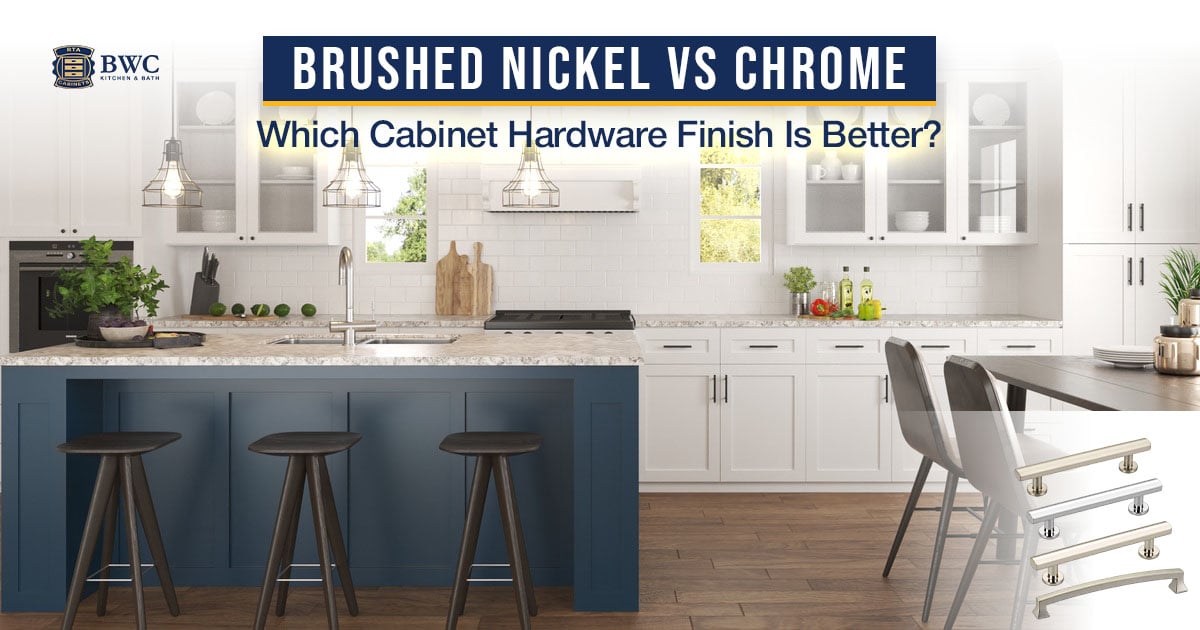
Brushed nickel vs chrome comes down to tone and upkeep. Chrome is a bright, mirror-like finish with a cool, slightly blue cast, and it shows every fingerprint and water spot. Brushed nickel is a softer, warmer gray with a fine grain that hides smudges and small scratches. Choose chrome for a crisp, cool kitchen you don’t mind wiping down; choose brushed nickel if you want a forgiving finish that works with both warm and cool cabinet colors. Either way, match the hardware to your faucet first.
Most people who search this are standing in a store aisle holding two pulls that look almost identical under the fluorescent lights. Then they get home and the difference is obvious. This guide covers the two finishes you came for, the three that usually get mixed up with them (satin nickel, polished nickel and stainless steel), how each one wears, and which finish suits which cabinet color.
The Silver Finishes at a Glance
| Finish | Tone | Fingerprints and water spots | How it wears | Relative cost |
|---|---|---|---|---|
| Polished chrome | Cool, bright, slightly blue | Shows everything | Hard surface, resists scratches; worn spots are rare but obvious | Usually the lowest |
| Brushed nickel | Warm gray with visible grain | Hides most smudges | Grain masks light scratches | Mid-range |
| Satin nickel | Warm gray, smoother and more even than brushed | Hides most smudges | Similar to brushed nickel | Mid-range |
| Polished nickel | Warm, soft yellow or champagne cast | Shows fingerprints, less harshly than chrome | Can mellow or tarnish over time if it has no clear coat | Usually the highest |
| Stainless steel | Cool gray, matches stainless appliances | Good with a brushed texture | Solid metal, so there is no plating to wear through | Mid to high |
Why These Finishes Look Different
Most cabinet knobs and pulls are made from zinc, brass or steel, then plated. The finish name tells you what sits on the surface and how that surface was treated.
- Chrome is a thin layer of chromium electroplated over a nickel base layer. Chromium is very hard and reflects a cool, blue-white light, which is where the crisp look comes from.
- Nickel finishes (brushed, satin and polished) are nickel plating with different surface treatments. Nickel reflects warmer light than chromium, so even polished nickel reads softer than chrome.
- Brushed and satin finishes are made by abrading the surface after plating. Brushing leaves fine directional lines; satin leaves a smoother, more uniform low sheen.
- Stainless steel hardware is usually solid stainless alloy rather than a plating. There is nothing to wear through, and the tone is cooler and grayer than nickel.
- PVD coatings (physical vapor deposition) are a separate process used on many modern finishes. A PVD-coated finish is typically more resistant to wear than a standard plating in the same color, which matters most on darker and warmer finishes such as black and brass.
Brushed Nickel vs Chrome
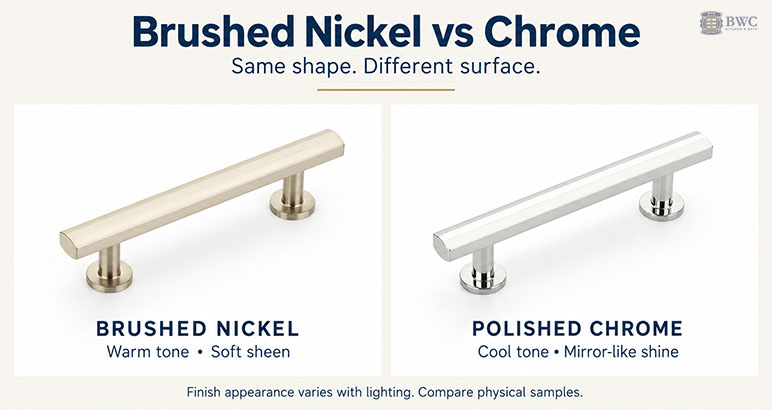
Tone. Chrome is the cooler of the two, with a faint blue cast that looks crisp next to white, gray and blue. Brushed nickel has a warm gray undertone that sits comfortably next to cream, wood and warm whites as well as cool colors. If you line them up in daylight, chrome looks like a mirror and brushed nickel looks like soft metal.
Upkeep. This is the biggest practical difference. Chrome’s mirror surface shows fingerprints, water spots and cooking grease the moment they land. Brushed nickel’s grain scatters light, so the same marks mostly disappear. On a sink base or a trash pull-out that gets touched with wet hands every day, you will notice.
Durability. Chrome is harder and resists scratching well, but on a mirror finish any scratch that does happen is easy to see. Brushed nickel is slightly softer, yet its texture hides light wear. Both hold up for years on quality hardware; the cheapest pieces of either finish are where plating problems show up.
Style. Chrome leans contemporary and clean. Brushed nickel leans transitional and goes with almost any door style, from a flat slab to a classic shaker.
Pick chrome if your faucet is chrome, your palette is cool (white, light gray, blue), and you don’t mind wiping handles.
Pick brushed nickel if you want the low-maintenance option, your kitchen mixes warm and cool tones, or you are still undecided. It is the finish least likely to clash with whatever you choose later.
Satin Nickel vs Brushed Nickel
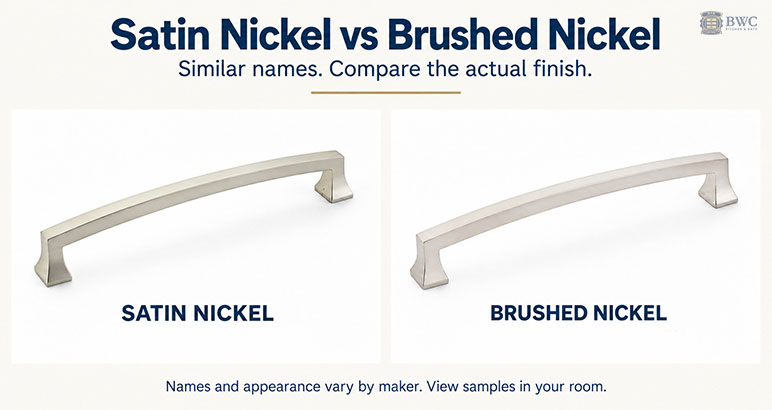
These two get compared more than any other pair, and the honest answer is that they overlap heavily. There is no industry standard that separates them, so one manufacturer’s satin nickel can look like another’s brushed nickel.
When a maker offers both, the difference is usually this:
- Brushed nickel shows fine directional lines you can see up close, and often a slightly darker, more textured look.
- Satin nickel is smoother, with a more even, low-sheen surface and little or no visible grain.
What matters more than the name: buy all of your knobs and pulls from the same maker and, ideally, the same order. Two brands’ “brushed nickel” can differ enough in tone to look mismatched on neighboring drawers. If your faucet is already installed, hold a sample pull next to it before you order a full set.
Polished Nickel vs Chrome
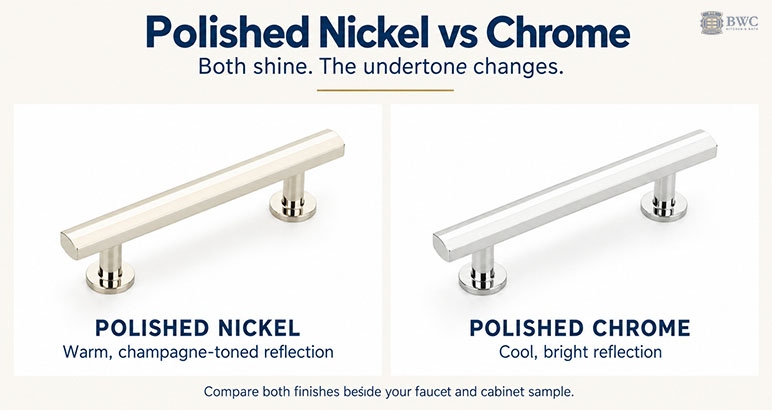
Both are shiny, which is why they get confused. The difference is the color of the shine.
- Chrome reflects a cool, blue-white light.
- Polished nickel reflects a warmer, softer light with a slight yellow or champagne cast.
Polished nickel suits warm whites, cream and traditional door styles, where chrome can feel a little cold. Chrome suits bright whites, grays and a more modern look. Polished nickel usually costs more, and a finish with no clear protective coat can mellow or tarnish over time. Some homeowners like that; if you don’t, ask whether the finish has a protective coating before you buy.
Brushed Nickel vs Polished Nickel
This is the same metal with two different surfaces. Brushed nickel is matte and textured, so it hides fingerprints and wear. Polished nickel is reflective, so it looks dressier but shows marks the way chrome does, only in a warmer tone. For a busy family kitchen, brushed is the practical choice; polished nickel works well on a few statement pieces such as appliance pulls or an island.
Brushed Nickel vs Stainless Steel
From across the room, most people can’t tell them apart. Up close, stainless steel is cooler and grayer, and brushed nickel is warmer.
The deciding factor is usually your appliances. If your refrigerator, range and dishwasher are stainless, stainless steel pulls match them exactly, and the handles right next to the appliances will look intentional. If your appliances are black, white or panel-ready, brushed nickel is the warmer, more flexible option.
Chrome vs stainless steel follows the same logic: chrome is shinier and bluer, stainless is a cooler gray with less shine. Next to a stainless range, brushed stainless blends in and chrome stands out.
When None of the Silver Finishes Is Right
Sometimes the best answer is not a silver finish at all. Two alternatives come up most often:
- Matte black gives strong contrast on light cabinets and a modern edge on natural wood. It hides water spots better than chrome, but hand oils can leave visible smudges on a flat matte surface. Look for a PVD or powder-coated finish rather than paint, which is more likely to chip at the edges.
- Brushed brass or gold adds warmth, and it is at its best on dark and saturated colors: black, navy and green.
Which Finish Works with Which Cabinet Color
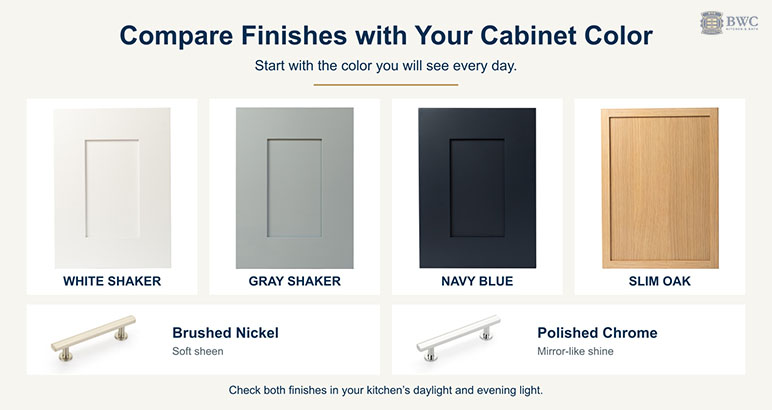
These are starting points drawn from what looks right in finished kitchens, not rules. Always check against your faucet and appliances.
| Cabinet color | Strongest finishes | Handle with care |
|---|---|---|
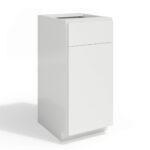
| White shaker cabinets | Brushed nickel, polished chrome, matte black, brushed brass | Almost nothing clashes with white; polished nickel next to a very cool white can look slightly yellow |
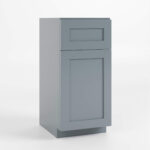
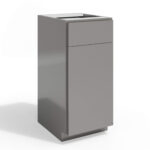
| Gray shaker cabinets | Matte black, brushed nickel, polished chrome | Warm brass, unless you repeat it in lighting or stools |
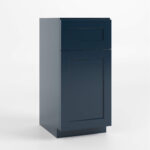
| Navy blue shaker cabinets | Brushed nickel, brushed brass, polished chrome | Matte black, which gets lost against deep blue |
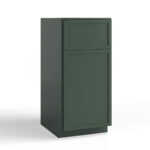
| Green kitchen cabinets | Brushed brass, brushed nickel | Polished chrome, which can look cold against sage and olive tones |
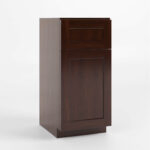
| Espresso shaker cabinets | Brushed nickel, stainless steel, brushed brass | Matte black, which disappears on dark wood tones |
| Black shaker cabinets | Brushed brass, brushed nickel, polished chrome | Matte black, unless you want a deliberately hardware-free look |
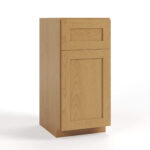
| Slim oak shaker cabinets | Matte black, brushed nickel | Polished chrome, which can feel sterile against warm wood |
For kitchens that combine two cabinet colors, the same logic applies to each run; our guide to two-tone kitchen cabinets covers how to balance them.
Match Your Faucet First, Then Everything Else
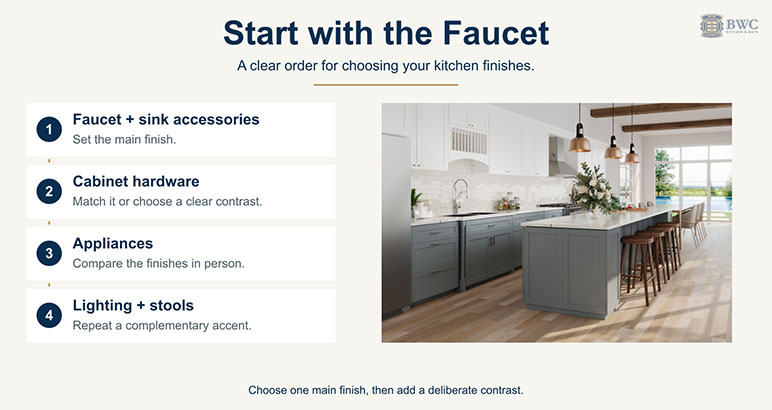
The faucet is the largest and most-used piece of metal in the kitchen, so it sets the finish family. Hardware that matches the faucet reads as a plan. Hardware that almost matches it reads as a mistake.
A simple order of decisions:
- Faucet and sink accessories set the primary finish.
- Cabinet hardware matches the faucet, or deliberately contrasts with it (for example, brushed nickel faucet with matte black pulls). Near-matches are what look wrong.
- Appliances are usually stainless, black or panel-ready. If they are stainless, lean toward brushed nickel or stainless hardware.
- Lighting and stools are where a second, warmer metal can come in without competing.
Two finishes in one kitchen is usually the limit. A common split is one finish on the perimeter cabinets and another on the island.
How to Clean Each Finish
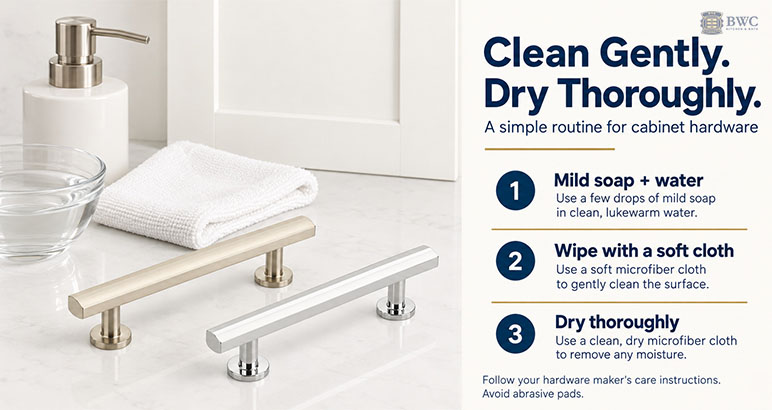
- Chrome: warm water with a drop of dish soap, then dry with a microfiber cloth to prevent water spots. Skip abrasive pads.
- Brushed and satin nickel: mild soap and water, wiping with the grain. Avoid abrasive cleaners, which can scratch the grain unevenly and leave a shiny patch.
- Polished nickel: mild soap and water, dried right away. Avoid ammonia, bleach and abrasive polishes, which can dull or strip a protective coat.
- Stainless steel: mild soap and water, wiping with the grain, dried with a soft cloth.
- Matte black and brass: a damp cloth and mild soap only; harsh cleaners are the fastest way to damage a coated finish.
Our guide on how to clean kitchen cabinets covers the cabinet surfaces around the hardware.
Before You Order Hardware
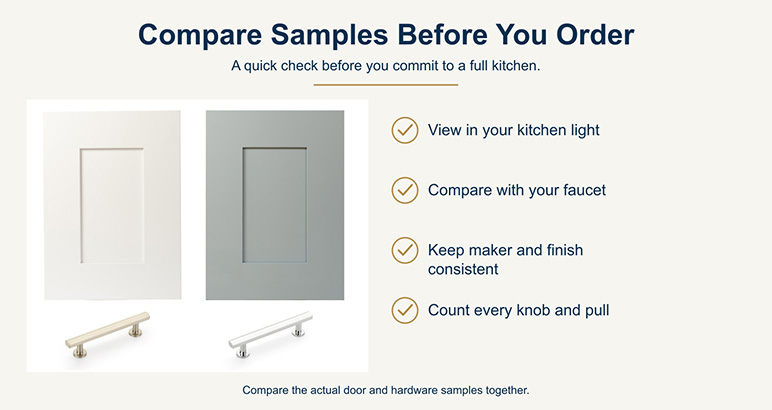
- See both finishes against your cabinet color in your own light. Kitchen lighting changes how every metal reads. Our sample doors let you hold a pull against the real door color before you commit to a full kitchen.
- Buy every piece from one maker and one order. Finish tones drift between brands and batches.
- Count before you buy. A typical approach is knobs on doors and pulls on drawers; tall pantry doors and appliance panels often take longer pulls.
- Check how the finish is made. PVD and quality plating outlast painted finishes, especially on black and brass.
Our RTA cabinets ship flat in 7–10 business days nationwide, at up to 40% less than big-box pricing, so you can settle the hardware finish while the cabinets are on the way.
FAQ
Is brushed nickel or chrome more timeless?
Both have been standard finishes for decades. Chrome is tied more closely to a crisp, contemporary look, while brushed nickel is more neutral and fits traditional, transitional and modern kitchens alike, which makes it the safer long-term choice for most homes.
Is brushed nickel out of style in 2026?
No. Warm metals and matte black get more attention in design media, but brushed nickel is still offered as a standard finish in most hardware lines, and it remains one of the easiest finishes to match with faucets and appliances.
What are the cons of brushed nickel?
It costs more than chrome, and its warm undertone can look slightly off next to stainless steel appliances. Tones also vary between brands, so pieces bought from different makers may not match.
Is satin nickel the same as brushed nickel?
Not exactly, but they overlap. Brushed nickel usually shows fine directional lines, while satin nickel is smoother and more even. There is no industry standard, so compare samples from the same manufacturer.
Does brushed nickel rust?
Nickel itself does not rust. Most brushed nickel hardware is nickel plating over a base metal, so if the plating is scratched through on a steel base, that spot can corrode. Quality plating and PVD-coated finishes hold up best.
Is polished nickel the same as chrome?
No. Both are shiny, but chrome has a cool, blue-white cast and polished nickel has a warmer, slightly yellow cast. Polished nickel usually costs more.
Can you mix brushed nickel and chrome in the same kitchen?
You can, but the two are close enough that they often look like a mismatch rather than a choice. Mixing works better with contrast, such as brushed nickel with matte black or brushed brass.
What color is brushed nickel?
Brushed nickel is a soft, warm gray with a matte, lightly grained surface. It looks warmer than chrome and stainless steel, and cooler than brass.