


 Sales:
  Customer Service:
Off-White Kitchen Cabinets: Ivory White, Pure White and Cream Compared

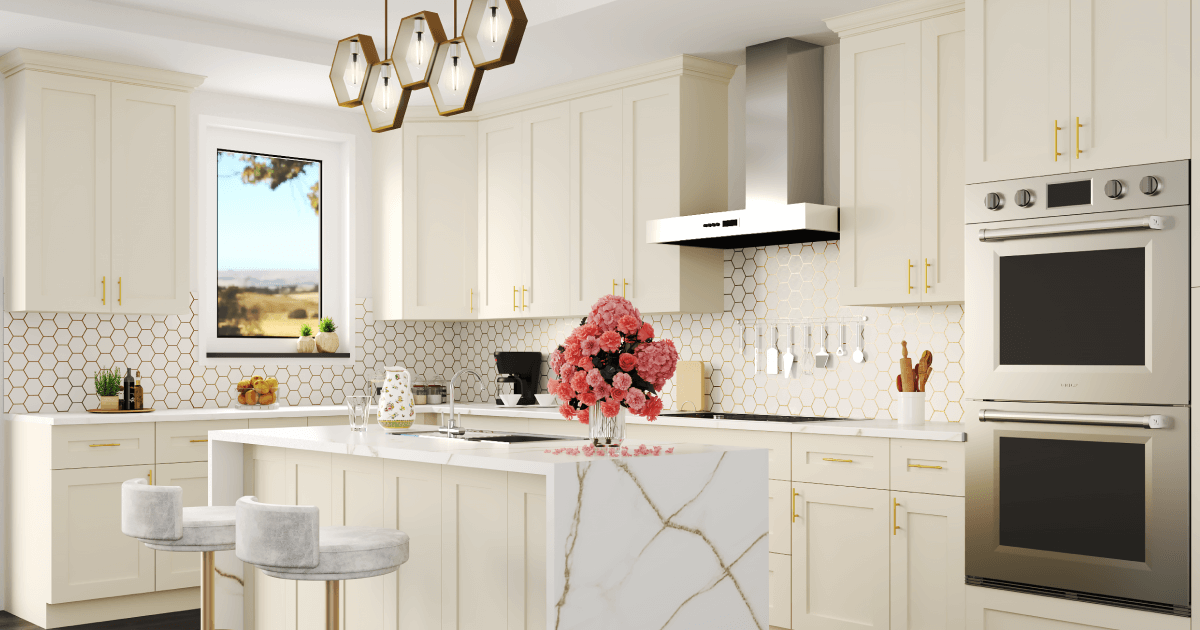
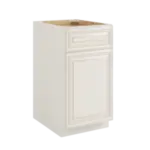
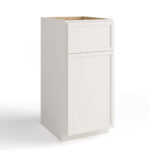
Off-white kitchen cabinets sit between pure white and cream. They are warm enough to soften harsh lighting, and clean enough to avoid the dated yellow that true cream carries. The most reliable off-white for cabinetry is a warm neutral with a soft beige undertone rather than a yellow one, because a beige-leaning off-white holds its color under both LED and natural daylight. Our Ivory White line is that shade, built on a 3/4-inch plywood box with a 3/4-inch solid birchwood door frame. Off-white also hides fingerprints and everyday cooking smudges noticeably better than bright white does.
That last point is the one homeowners tend to discover after installation rather than before. Pure white looks decisive in a showroom and unforgiving in a working kitchen. Off-white gives you the same brightness with a much wider tolerance for real life. Here is how the three shades actually differ, what the best off-white looks like, and what to put next to it.
In this guide:
- Off-white vs pure white vs cream
- What the best off-white actually looks like
- Are off-white cabinets going out of style?
- How Ivory White is built
- Four off-white kitchen designs that work
- What to pair with off-white cabinets
- Which kitchen sizes off-white suits best
- What Ivory White is available in
- FAQ
Off-White vs Pure White vs Cream
The fastest way to understand off-white is to see all three side by side. These are the differences that show up in a finished room, not on a color chip.
| Shade | Undertone | How it reads | Behavior under light | Best paired with |
|---|---|---|---|---|
| Pure / bright white | Cool, crisp neutral | Sharp, contemporary, can read sterile | Shifts hard. Cool under LED, glaring in direct sun | Dark stone, high-contrast modern schemes |
| Off-white / ivory | Warm neutral, soft beige | Calm, refined, intentional | Holds steady. Warms slightly under LED, stays neutral in daylight | White oak, brass or matte black hardware, veined quartz |
| Cream / antique | Pronounced yellow | Traditional, distinctly classic | Pulls further yellow under warm bulbs | Country, cottage and heavily aged vintage schemes |
The practical summary: pure white is a commitment to contrast, cream is a commitment to a traditional look, and off-white is the shade that stays flexible if the rest of the room changes later.
When pure white is the better call. If you are building an ultra-high-contrast modern kitchen, with honed black granite, a dark slab backsplash and polished concrete floors, pure white is the cleaner partner. Off-white’s warmth works against those cool choices rather than with them. Our white shaker cabinets cover that brief.
When cream is the better call. If the whole house is deliberately traditional, with cream trim and warm unlacquered metals running through it, full cream reads more cohesive. For anything modern or transitional, ivory white cabinets give you the warmth without the yellow.
What the Best Off-White Cabinet Color Actually Looks Like
“Off-white” covers a wide range, and the range is where people go wrong. Two cabinet doors can both be sold as off-white and read completely differently on a wall.
The variable that matters is the undertone. An off-white with a beige or greige undertone stays neutral across lighting conditions. An off-white with a yellow undertone looks warm and inviting under incandescent bulbs and turns distinctly buttery under cool LEDs, which is the single most common regret in this color family. An off-white with a pink or mauve undertone is rare in cabinetry but unforgiving next to gray stone.
Three things to test before you commit:
- Order a sample door and look at it in your own kitchen. Not a printed chip, and not a screen. Sample doors are available for exactly this reason, and lighting in your room is the only test that counts.
- Check it against your trim and your ceiling. Off-white cabinets next to a cool bright-white trim will read yellow by comparison. Either match the warmth or make the contrast deliberate.
- Look at it in the afternoon and again at night. A finish that behaves in both is a finish you will still like in three years.
Are Off-White Kitchen Cabinets Going Out of Style?
No, and the reason is structural rather than fashionable. Off-white is a neutral, and neutrals do not cycle the way saturated colors do. The cabinet colors that date are the ones that were a trend statement in the first place: the heavy espresso of the mid-2000s, the cool gray that peaked around 2018, and the yellow-leaning cream of the 1990s.
What has changed is which end of the white family buyers pick. Demand has shifted from stark bright white toward warmer, softer whites, because bright white reads cold in the open-plan layouts that are now standard. Off-white is where that demand landed.
If you are worried about resale, off-white is close to the safest cabinet decision available. It coordinates with a wide range of countertops and floors, it does not fight the wall color a future owner picks, and it does not signal a particular year. For a wider view across the range, our guide to the best RTA cabinet colors compares the full set.
How Ivory White Is Built
Color is the reason people choose a cabinet and construction is the reason they keep it. Ivory White is part of our frameless line, and the specs below are the frameless build.
| Component | Specification |
|---|---|
| Box | 3/4-inch furniture-grade plywood |
| Door frame | 3/4-inch solid birchwood, mortise and tenon joints |
| Door center panel | MDF on painted lines, for a flat, crack-free paint surface within CARB2 limits |
| Finish | Painted doors with a UV coating |
| Hinges | Concealed, soft-close, 6-way adjustable |
| Drawers | Solid wood dovetail boxes on full-extension under-mount soft-close glides |
| Shelves | 3/4-inch plywood, adjustable, metal clips |
| Compliance | CARB2 compliant |
Two of those lines deserve a sentence of honesty, because the cabinet industry is vague about both.
Plywood boxes, solid wood frames and doors, soft-close hardware. Painted lines use MDF center panels for a flawless, crack-free finish, and every panel sits within CARB2 limits. MDF in a painted door panel is not a downgrade. It is the correct material choice: a solid wood panel expands and contracts with humidity, and on a painted door that movement eventually shows as a hairline crack at the panel edge. A dense, flat MDF panel does not move, so the paint stays intact. The frame around it, the part that carries the structural load, is solid birchwood.
The 6-way adjustable hinge is the spec to compare. It lets a door be corrected up, down, in, out, and tilted on two axes after installation, which is what keeps gaps even as a house settles and floors move. Entry-level cabinetry generally offers fewer axes of adjustment, and the difference only becomes obvious a year in, when doors drift out of alignment and there is no way to bring them back. Ask any supplier how many axes their hinges adjust on before you compare prices.
For more on what goes into a flat-pack cabinet, see are RTA cabinets good quality.
Four Off-White Kitchen Designs That Work
1. A full off-white run. Every cabinet in the same shade, base to ceiling. This is the strongest choice in small and mid-size kitchens, where uninterrupted color makes a compact footprint read larger. Pair it with a warm quartz counter and brushed nickel hardware.
2. Off-white perimeter, saturated island. Keep the run in off-white and put the color in the island. Off-white takes a dark island better than pure white does, because the warmth keeps the contrast from turning stark. It works with navy blue shaker cabinets, black shaker for a harder modern edge, or espresso for something warmer and more traditional.
3. Open-plan tone bridge. In a layout where the kitchen runs straight into the living space, off-white connects the hard kitchen surfaces to the softer furniture and textiles next to them. Pure white tends to mark the kitchen as a separate zone. Off-white blurs the line, which is usually the goal in an open plan.
4. Floor-to-ceiling pantry walls. Tall cabinetry in a dark color reads as bulk. In off-white, a full wall of pantry towers bounces light back into the room and reads as architecture instead of storage. This is the best use of off-white in a narrow galley layout.
What to Pair With Off-White Cabinets
Countertops
| Material | Effect against off-white | Best fit |
|---|---|---|
| Calacatta quartz | Warm white ground with gold and gray veining that echoes the cabinet tone | Transitional |
| Carrara marble | Cooler gray veining, balanced contrast against the warm doors | Classic |
| Butcher block or walnut | Warm wood against warm white, the softest pairing available | Farmhouse, cottage |
| Soapstone or honed black granite | Hard, graphic contrast that anchors the room | Contemporary |
A note on white quartz: it works, but pick a slab with gray or gold veining. A flat white quartz next to a warm white cabinet reads as a mismatch rather than a match.
Hardware
| Finish | Behavior | Best fit |
|---|---|---|
| Brushed nickel | The most forgiving option. Hides fingerprints, coordinates with stainless appliances | Everyday transitional |
| Satin brass or gold | Warm on warm, reads deliberately high-end | Modern organic |
| Matte black | A crisp structural line that cuts through the soft white | Industrial, contemporary |
Flooring and backsplash
| Selection | Chemistry with off-white | Aesthetic |
|---|---|---|
| Natural white oak | The strongest pairing in the list. Neutral, clean, warm | Modern organic |
| Honey hardwood or hickory | Grounded and welcoming | Traditional, rustic |
| Light gray LVP | A cool-toned counterbalance, durable and practical | Practical contemporary |
| White subway tile | Timeless. Use warm gray grout for cohesion, bright white for contrast | Any |
| Zellige tile | Irregular glaze catches light across the room | Choose cream or warm white variants |
Which Kitchen Sizes Off-White Suits Best
Off-white is one of the more size-forgiving finishes, for different reasons at each end.
- Under 100 sq ft. Expands the visual footprint and brightens low-light corners. It also hides smudges better than bright white, which matters more in a tight kitchen where every surface gets touched.
- 100 to 200 sq ft. Works in either a monochrome run or a two-tone layout, and carries open shelving and a darker island without strain.
- 200 sq ft and up. Avoids the blinding effect pure white creates over a large expanse, and balances tall pantry runs and an oversized island without dominating the room.
Cabinet color is a finish decision. Cabinet layout is a structural one, and the two should be settled separately. Before you order, work through kitchen cabinet sizes and how to measure kitchen cabinets, which cover clearances, door swings and standard dimensions properly.
What Ivory White Is Available In
The line covers a full kitchen and a bathroom: base cabinets, wall cabinets, pantry cabinets, vanity cabinets, fillers and panels, moulding and toe kick, and accessories. That range matters more than it sounds, because a color that stops at base and wall cabinets forces a compromise at the pantry wall or the vanity.
Browse the full range of ivory white cabinets, or see how the shade sits against the rest of the RTA kitchen cabinets catalog. For a bathroom in the same finish, the RTA vanity cabinets range handles humidity well and pairs cleanly with marble-look quartz.
Why Buy Off-White Cabinets From Us
- Up to 40% below big-box pricing, with wholesale pricing on every order and no program signup
- 7–10 business day delivery, nationwide
- Sample doors available before you commit to a full layout
- Wide range of colors and styles across 6 lines
- Price-match guarantee
Sample doors are the exception to our $2,000 minimum, and they ship free.
Frequently Asked Questions
What is the best off-white color for kitchen cabinets?
The best off-white for cabinetry is a warm neutral with a soft beige or greige undertone rather than a yellow one. A beige-leaning off-white holds its color under both LED and natural daylight, while a yellow-leaning off-white turns buttery under cool LEDs. Order a sample door and view it in your own kitchen lighting before committing, because printed chips and screens both misrepresent undertone.
Are off-white kitchen cabinets going out of style?
No. Off-white is a neutral, and neutrals do not cycle the way saturated colors do. Buyer preference within the white family has shifted from stark bright white toward warmer, softer whites, because bright white reads cold in open-plan layouts. The cabinet colors that date are the ones that were trend statements to begin with, such as heavy espresso or cool gray.
What is the difference between off-white, ivory and cream cabinets?
All three are warmer than pure white, and the difference is how much yellow each carries. Off-white and ivory are warm neutrals with a soft beige undertone that read clean and current. Cream carries a pronounced yellow undertone and reads distinctly traditional. In practice, ivory sits just a fraction warmer than pure white without crossing into yellow.
Do off-white cabinets show dirt more than white cabinets?
Less, not more. The warm undertone and slightly lower brightness of off-white disguise fingerprints, water spots and light cooking residue that show clearly on bright white. A factory UV-coated paint finish also wipes clean easily. Use a soft cloth with warm water and a drop of mild dish soap, and avoid abrasive pads, bleach and ammonia-based cleaners on any painted cabinet finish.
Are white cabinets out of style in 2026?
No. White remains one of the most widely chosen cabinet colors, and it stays in use because it works with almost any counter, floor and hardware choice. What has moved is the shade. Stark, cool bright white is giving ground to warmer whites and off-whites, which read softer in open-plan rooms. If you like white but worry about it looking cold, a warm off-white keeps the brightness without the glare.
What countertop goes with off-white cabinets?
Calacatta quartz is the most reliable pairing, because its warm white ground and gold-gray veining echo the cabinet tone. Carrara marble adds a cooler contrast, butcher block gives the softest warm-on-warm result, and honed black granite or soapstone creates a hard graphic contrast. If you choose a white quartz, pick a slab with visible gray or gold veining so the counter does not read flat against the warm doors.
Ready to see the color in person? Order a sample door, or browse the full ivory white cabinets range.