

 Sales:
  Customer Service:
Why we build with MDF - and how it compares to HDF and plywood.
MDF is the engineered wood we choose for the parts of a cabinet where a smooth, stable, paint-ready surface matters most. Here's what it is, where it wins, and how it stacks up against HDF and plywood.
MDF at a glance
What MDF actually is
A plain-English look at the material and why it behaves the way it does.
MDF (Medium-Density Fiberboard) is an engineered wood made by breaking down real hardwood and softwood into fine fibers, then bonding them under heat and pressure into dense, uniform panels.
Because there's no grain and no knots, the surface is exceptionally smooth and consistent - which is exactly why it takes paint so well. A painted MDF door has no grain telegraphing through the finish, giving that clean, factory-smooth look.
It's also dimensionally stable: it doesn't expand, contract, or crack the way solid wood can as humidity shifts. That stability is what makes it a reliable core for painted doors and flat panels.
Which material, for which job
None of these is "best" across the board - each wins at different things. Here's the honest breakdown.
| Feature | MDF | HDF | Plywood |
|---|---|---|---|
| What it is | Medium-density wood fiber, bonded into uniform panels | High-density wood fiber - same idea as MDF, but denser | Thin wood veneers cross-layered and glued |
| Surface & finish | Smoothest - ideal for paint | Very smooth, takes paint well | Wood grain shows - better for stain |
| Stability | Excellent - won't warp or crack | Excellent - very rigid | Good, but veneers can delaminate if soaked |
| Density & weight | Medium (600–800 kg/m³) | High (800+ kg/m³), heavier | Lighter for its strength |
| Strength to hold screws | Good in panels & doors | Strong | Strongest - best for load-bearing boxes |
| Best used for | Painted doors & flat panels | Door skins, laminate flooring cores | Cabinet boxes & structural parts |
| In short | MDF and plywood aren't rivals - they do different jobs. Plywood is built for structure; MDF is built for a flawless painted surface. Good cabinetry uses each where it performs best. | ||
What MDF does best
We use MDF where its strengths matter most - painted doors and panels. Three reasons it earns that spot.
Flawless painted finish
No grain, no knots - paint goes on perfectly smooth with nothing telegraphing through. The hallmark of a clean painted door.
Stays true over time
Dimensionally stable across humidity swings - it resists the warping and joint-cracking that can affect solid wood panels.
Consistent, every panel
Engineered uniformity means no weak spots or surprises - every door panel behaves the same, finish after finish.
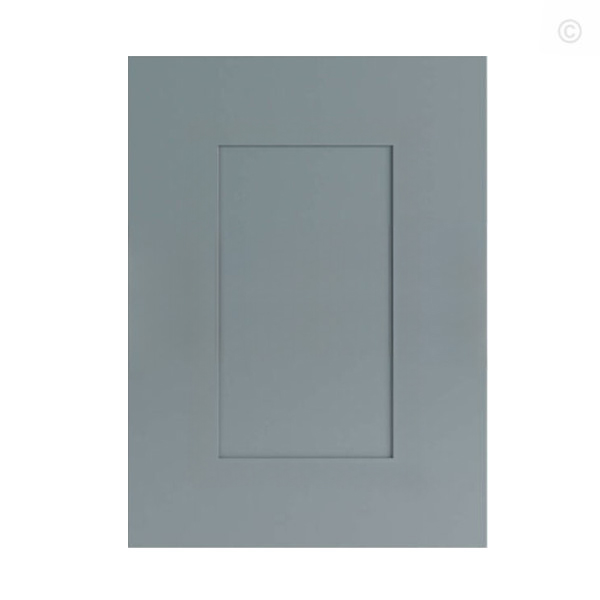
Right material, right place
- Painted door center panels. Where MDF's smooth, grain-free surface gives a flawless factory-painted finish.
- Flat panels & details. Stable, consistent surfaces that hold their shape and finish over years of daily use.
- CARB2 compliant. The MDF we use meets CARB Phase 2 and TSCA Title VI formaldehyde emission standards.